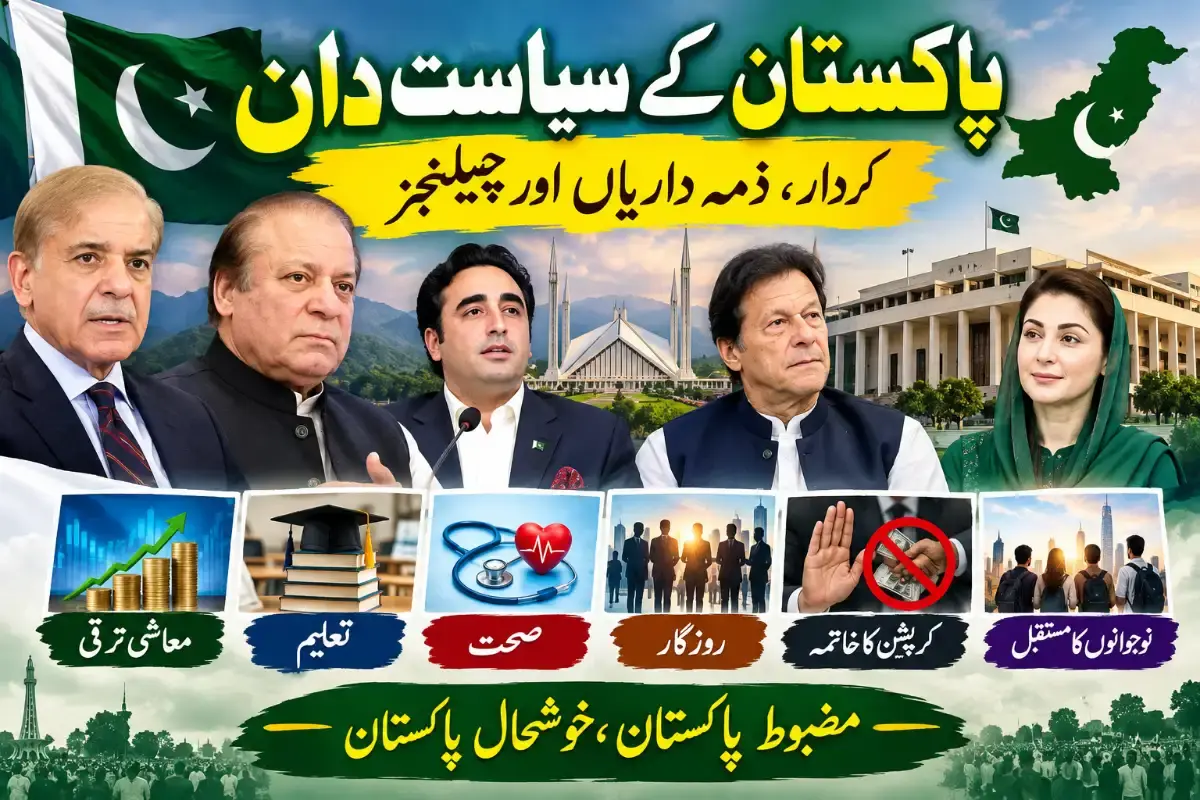
Politicians of Pakistan: Their Role, Challenges and Responsibilities
Pakistan is a country with a rich political history, a large population, and a strong desire for democratic development. Since its independence in 1947, Pakistan has experienced many political changes, including democratic governments, military rule, constitutional developments, political movements, and changes in leadership. Pakistani politicians have played an important role in shaping the country's political, economic, and social direction. Some politicians have made significant contributions to the country, while others have faced criticism because of corruption allegations, political conflicts, poor governance, and failure to meet public expectations.
Politics is an essential part of every democratic country. Politicians are elected by the people to represent their interests and work for the development of the country. In Pakistan, politicians represent different political parties, regions, communities, and schools of thought. Major political parties have played important roles in national and provincial politics. Their leaders have different political ideologies and approaches, but all politicians should ultimately work for the welfare of Pakistan and its people.
One of the most important responsibilities of Pakistani politicians is to strengthen democracy. Democracy cannot become successful merely through elections. It requires strong institutions, respect for the Constitution, freedom of expression, accountability, and peaceful political competition. Political leaders should accept election results, respect Parliament, and resolve political disagreements through dialogue and constitutional methods. Political differences are natural in a democracy, but personal attacks, violence, hatred, and political instability can damage democratic institutions.
Another major responsibility of politicians is economic development. Pakistan faces several economic challenges, including inflation, unemployment, poverty, debt, energy problems, and a shortage of investment opportunities. Political leaders must develop long-term economic policies rather than focusing only on short-term political gains. Pakistan needs policies that encourage businesses, support agriculture, improve exports, attract investment, and create employment opportunities for young people.
Education should also be a major priority for Pakistani politicians. A country cannot progress without an educated and skilled population. Pakistan has a large young population, which can become a great strength if young people receive quality education and vocational training. Politicians should focus on improving schools, colleges, universities, technical institutions, and research facilities. Equal educational opportunities should be provided to children from both urban and rural areas.
Healthcare is another important area where politicians have a major role to play. Many people, particularly in less developed areas, do not have easy access to quality medical facilities. Governments should improve hospitals, basic health units, emergency services, medicines, and healthcare infrastructure. Special attention should be given to women, children, elderly people, and people living in remote areas.
Corruption is one of the most serious concerns associated with politics in Pakistan. Different politicians and political leaders have faced allegations of corruption over the years. However, allegations should always be investigated through lawful and transparent processes rather than being used simply as political weapons. Pakistan needs an effective system of accountability that applies equally to politicians, government officials, businesspeople, and other powerful individuals. Accountability should be based on evidence, law, and due process.
Pakistani politicians also have an important responsibility to improve local development. Roads, clean drinking water, sanitation, electricity, public transport, schools, hospitals, and employment opportunities are basic needs of citizens. Politicians should remain connected with their constituencies and understand the everyday problems faced by ordinary people. Development projects should be selected according to public needs rather than political favoritism.
Another important issue is political polarization. Pakistan has witnessed intense political competition between different parties and their supporters. Political disagreement can be healthy, but extreme polarization can divide society. Politicians should avoid language that creates hatred among citizens. They should encourage tolerance and respect for different opinions. Supporters of different political parties should also understand that political opponents are not necessarily enemies of the country.
The media and social media have changed Pakistani politics significantly. Politicians can now communicate directly with millions of people through television, Facebook, YouTube, X, TikTok, and other platforms. This provides opportunities for greater public engagement, but it also creates challenges. False information, edited videos, personal attacks, and political propaganda can spread rapidly. Responsible politicians should use social media to provide accurate information and communicate constructive political messages.
Pakistan's foreign policy is another important responsibility of its political leadership. Pakistan has important relationships with neighboring countries and major international powers. Politicians and policymakers must protect Pakistan's national interests while promoting peace, trade, investment, and regional cooperation. A stable economy and strong diplomatic relationships can improve Pakistan's position in the international community.
The youth of Pakistan also deserve special attention from political leaders. Millions of young Pakistanis want education, jobs, modern skills, and opportunities to build successful careers. Politicians should develop policies that encourage entrepreneurship, information technology, freelancing, technical education, sports, and innovation. If the potential of young people is properly utilized, they can become one of Pakistan's greatest national assets.
Women should also have an active role in Pakistan's political and social development. Pakistani women have contributed significantly to education, healthcare, business, public administration, politics, and many other fields. Political parties should provide greater opportunities for capable women to participate in decision-making and public leadership.
In conclusion, politicians are an important part of Pakistan's democratic system. The progress of the country depends not only on individual leaders but also on strong institutions, responsible citizens, an independent legal system, and effective governance. Pakistani politicians should put national interests above personal and party interests. They should respect the Constitution, strengthen democracy, fight corruption through lawful accountability, improve the economy, invest in education and healthcare, create employment, and listen to the concerns of ordinary citizens.
Pakistan has enormous potential. It has a young population, talented professionals, natural resources, fertile agricultural land, strategic importance, and a rich cultural heritage. What the country needs is political stability, honest leadership, effective institutions, and consistent long-term policies. If Pakistani politicians work together despite their political differences and focus on the welfare of the people, Pakistan can move toward a more peaceful, prosperous, and stable future.
No comments yet. Be the first to comment!